When I was living in Venezuela, I lived in a city of the Guaros, Barquisimeto. Today I want to share some information concerning intercity traveling in Venezuela, or the parts that I had the pleasure of visiting.
First as a foreigner, people might scare you a bit. They might tell you that public transport is dangerous and you should go by car or by plane. They can give you some very depressing accounts of bus raids.
In fact, in the Christmas I was there, two of my friends decided to take a bus to Colombia from Barquisimeto. But when they arrive at the bus stop, they were told that they should come back the next day as the bus had been raided when coming from Caracas. It was carrying football players. So if I can put it, sorry for the word, shit happens like in many other parts of the world.
Obvious planes are expensive and you might be left with public transport as your only option. What do you do? You take it. Many do and I did also. The later is expensive and the former is not available.
Buses
They are economical. In Barquisimeto for example, you can take the bus from the Centro. The area is not very safe, as you will be told and you will have to be careful, you will also be told. Don't take buses much into the night as you might need to wait for a bit. I have done that like two times and nothing happened. And either ways you will be inside. But don't test fate. Stay safe.
You can also take the buses by the name of Aeroexpresos which are running from the eastern part of the city; the safe part as it is known. They are bit expensive but they are more reputable. However, this is subjective depending on your luck. During my time, I once had a problem with them. As I was leaving Venezuela for good, the bus broke down in the middle of the road and I started worrying about what would happen if I will miss my plane from Caracas. Thanks god I was able to find another means of transport. But generally Aeroexpresos are more comfortable inside and are said to be more reliable.
Rapiditos
In other words, they are taxis which can take you from one place to another. You will pay more than the buses but they will be fast and you might get where you are going a bit ahead of the time. Having said that, I would like to share some misfortunes I faced with this means of transport the first time I was going to Caracas to catch my flight to Brazil. In the middle of the road, the rapidito broke down in the middle of the highway. Dangerous they will tell you. But the four passengers got out and took another bus by stopping it with a wave of a hand. And in no time we were in Caracas. As far an omen was following me, while coming back from Caracas to Barquisimeto I also took another rapidito from La Bandera station. At around 8 at night, the taxi broke down in the middle of nowhere. The driver didn't want to give our money back until the National Guards stopped and forced him to give our money back. They escorted us to a nearby city and we took another rapidito since it was very late into night to get a bus by then.
At the end of the day it boils down to your luck. But these are the best ways to go around.
The good things about buses in Venezuela like many in the developing world is their abundance. In the bus station you will always find one to jump on. In some you will have to wait a little bit so they can be full but when they are done you will be ready to go.
Coldness in the buses
Let no one fool you, the buses in Venezuela are cold. Bring a sweater or something else to cover yourself. In my experience the buses to Maracaibo and Valencia were pretty cold. So get ready.
One advice I will give is to do your research properly. Make sure you find the alternatives ways to go to where you want. When I used to ask my Venezuelan friends about which buses went to certain directions, most of them were oblivious since they had never taken them before. Find someone who knows, or go to the stop, or do anything to armor yourself with the information. There are always ways.
I hope I haven't left anything out :)
Saturday, March 9, 2013
Friday, March 8, 2013
Chavez No More
I have decided to come back and write something after many months of not writing about Venezuela. One apparent reason for not doing so is because I am not living in Venezuela anymore. But I think when the time permits I will come back and pen something.
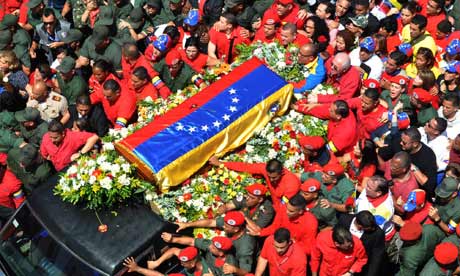
When I heard about Chavez's death, I actually doubted it as it has been rumored a couple of times before that he was dead. But after checking online and going to Wikipedia, it became obvious that the man who was leading the country at the time I was living in Venezuela was no more.
Any emotions? I am not sure. I mean I don't know how I really felt about Chavez. I know that is a lot of bull but when I look back I sometimes fail to see the image I want to portray in relation to how I felt about the man.
On one hand, he was advocating something which was good; something that my country used when we got our independence. Socialism, living together like brothers and being connected; at least that is what it means on the superficial level. And probably its most important pillar to me. But living in Venezuela I experienced a country which was divided between the rich and the poor. I experienced the anxiety that comes with the fear of being robbed while walking on the street or something bad happening to you. That is the life of many of the Venezuelans. I also felt and still feel that Chavez didn't do much to address that issue. The jails were not jails but strongholds of very feared gangs that would erupt in violence when they chose to do so, sending many to hospitals. In terms of security, I was not impressed by the pathway he was taking.
He had speeches that went on for hours. He would never stop; a clear feature of many of the socialist regimes, ask Argentinians.
But he really struggled and succeeded to support the poor. He was the first President and many would agree, both poor and rich that he was the first to look at the poor as his brothers. And he really mounted many programs to help them, using as much of the revenue from the vast oil resources to help them and advance the socialism ideals in South America.
I happened to live in both parts of the differing opinions. The rich who hated him really did so with passion. He took away private enterprises or made them hard to function because he believed they were imperialistic.
And we all know how he felt about the US.
But now the answer is what is going to happen to the country. Will things become better or deteriorate even further? Will his ideals prevail behind his supporters in the period where his charisma will never be matched by anyone from his team? These are tough questions and we will have to wait and see.
But having said all this, I am happy to have lived in Venezuela under his leadership and experience what I did. It was a brilliant opportunity and I think I came out strong and knowledgeable, critical and understanding of many things. I know many people ask me why I went to Venezuela among all countries. I never regretted my decision and I never will. It was a dream come true and regardless of how I feel or we feel about Chavez, may he rest in peace.
When I heard about Chavez's death, I actually doubted it as it has been rumored a couple of times before that he was dead. But after checking online and going to Wikipedia, it became obvious that the man who was leading the country at the time I was living in Venezuela was no more.
Any emotions? I am not sure. I mean I don't know how I really felt about Chavez. I know that is a lot of bull but when I look back I sometimes fail to see the image I want to portray in relation to how I felt about the man.
On one hand, he was advocating something which was good; something that my country used when we got our independence. Socialism, living together like brothers and being connected; at least that is what it means on the superficial level. And probably its most important pillar to me. But living in Venezuela I experienced a country which was divided between the rich and the poor. I experienced the anxiety that comes with the fear of being robbed while walking on the street or something bad happening to you. That is the life of many of the Venezuelans. I also felt and still feel that Chavez didn't do much to address that issue. The jails were not jails but strongholds of very feared gangs that would erupt in violence when they chose to do so, sending many to hospitals. In terms of security, I was not impressed by the pathway he was taking.
He had speeches that went on for hours. He would never stop; a clear feature of many of the socialist regimes, ask Argentinians.
But he really struggled and succeeded to support the poor. He was the first President and many would agree, both poor and rich that he was the first to look at the poor as his brothers. And he really mounted many programs to help them, using as much of the revenue from the vast oil resources to help them and advance the socialism ideals in South America.
I happened to live in both parts of the differing opinions. The rich who hated him really did so with passion. He took away private enterprises or made them hard to function because he believed they were imperialistic.
And we all know how he felt about the US.
But now the answer is what is going to happen to the country. Will things become better or deteriorate even further? Will his ideals prevail behind his supporters in the period where his charisma will never be matched by anyone from his team? These are tough questions and we will have to wait and see.
But having said all this, I am happy to have lived in Venezuela under his leadership and experience what I did. It was a brilliant opportunity and I think I came out strong and knowledgeable, critical and understanding of many things. I know many people ask me why I went to Venezuela among all countries. I never regretted my decision and I never will. It was a dream come true and regardless of how I feel or we feel about Chavez, may he rest in peace.
Sunday, September 23, 2012
Consumerism in Venezuela
Venezuela
is the country with soaring figures of consumerism in South America and the
world in general. According to figures, Venezuela consumes more Blackberry
phones than any other country in the world and more the Brazil and Mexico
combined.
Pretty
much everyone has a Blackberry or another expensive phone. Blackberry phones
signal fortune and wealth. If you have one you are definitely going to be taken
care more seriously.
Kids
from as young as the tender age of 10 own Blackberry phones. But also the poor
of the country are not behind. In fact there are stories of people who will say
they don’t have money but buy Blackberry phones because of the pervasive
pressure to go with times.
But
this consumerism doesn’t stop here. It goes along way up to the clothes, shoes
and cars. Moda is very important for
the Venezuelan people and the malls are always loaded with consumers who go out
with bags and bags of newly purchased merchandise.
But
not just in the expensive malls will you find shopaholics. In the downtown
famed for its affordability is where consumers swam the shops like bees, ladies
purchasing shoes and men new shirts.
As
I pass the narrow closed street of 20th Avenue where shops are lined
up on each side, I am not shocked anymore to be bumping with thousands of
shoppers tagging along their kids for a Saturday of new shoes and the like.
The
clothes shops filled with shoppers display goods on sale with 50% discount of
some selected merchandise. These shops have employed people special to speak on
loud speakers attracting customers with the sweetest words.
And
so as the day dies off, I have managed to buy boxers of about US$15, three
pairs of socks of US$2, a bag of about US$15 and a cheap cologne from a seller
who couldn’t stop talking of about US$10.
This
is part of the lives of many of the Venezuelans.
But
why such consumerism?
The Business of Sikarios
If one hates you enough to want to kill you,
one is able to do so in Venezuela. What one will do is have a price tag
attached to your name. One will then contact the professional killers, or
famously known as Sikarios to take
you down. In few days the job will be done and you will be no more.
And all this can be at a price of 500Bs
which is equivalent to about US$150.
According to the information I have
gathered, Sikarios started off as
professional killers, of Colombian citizenship present in Venezuela. The job of
killing was conducted by them. However today, Venezuelans are also doing the
job with gusto.
Mostly, the killings will be conducted by
guns which are illicitly obtained. One might be kidnapped first and then killed
afterwards or might be killed at an instant.
In order to carry out their operations, Sikarios will purchase a random Identity
Card to conduct their operations. These cards are mostly of deceased persons
but sometimes they might be of innocent people living which will end up
complicating matters.
A friend told me of his once dire situation.
Once while driving he was stopped by the police who conducted a checkup of his
vehicle. As part of the checkup process they asked for his ID.
The Rich and the Poor
Venezuelan colors are divided on several
lines. But indeed there are two major lines that seem pervasive, covering the
general population and owing to discussion.
As you have gathered from reading or visiting the country, its
population is highly mixed between the sons of this land, Spaniards, Italians,
Portuguese and Africans.
With this mixture you are bound to
encounter people like the colors of the rainbow, diverse and rich. From the
very light skin, European looking to very dark skinned as if picked from the
middle of the Nigerian soil. Everyone lays somewhere on this long color line.
But within this long line, a crossroad is
formed when another line crosses through it, dividing the population on two
sides, placing them into two different parts.
I only realized it when I decided to walk
around the Eastern part of Barquisimeto on a Saturday evening, trying to absorb
more of my surrounding. As I walked I met people on the road doing the same
thing as I.
Sunday, September 9, 2012
Insecurity in Venezuela
| Venezuela, one of the happiest country but clouded by the prevalence of insecurity |
Insecurity in Venezuela
is a naughty issue, scaring not only the locals but everyone thinking of
visiting the country. If one embarks on a thorough reading of the country while
deciding to visit, they might be persuaded to abandon their mission.
A friend who went to
Cuba narrated her experience while conversing with other lodgers in Backpack
hostel. Many of the tourists who had traveled extensively in the South American
continent eschewed touching Venezuela though it has the tallest waterfall
in the world.
This has led to the anti-Chavez sentiment due to the fact that the issue of insecurity is prevalent in
almost all states and towns of the country.
When you arrive you
will be explicitly warned over the duration you are here. That will be the topic
that you will meet while conversing with people for the first time. Everyone
will warn you to be careful.
This will include
wisdom about evading the worst part of this cities or that where people of low
income resides. It will also include not walking at night from the hours of 5
pm, though others will warn you to completely not walk at any time.
Saturday, September 1, 2012
Racism in Venezuela
Is there racial discrimination
in Venezuela?
No.
This is the answer you will get
from about 90 per cent or more of the population here in Venezuela. There is no
racial discrimination, only there are issues with classes, you would be told.
Venezuela presents a very
difficult fabric which is interwoven and mixed to the point nothing really
stands on its own purity. Venezuelans are mestizos
with a rich background that spans from both directions.
In fact, no matter how dark or
light-skinned Venezuelans are, most of them they will tell you that they are mestizos. There is a tendency of
generalizing and drawing similarities making everyone racially the same.
It is also very common for
families to have some children that look very light-skinned and refer to them
as Catires and have others with the
darkest skin and refer to them as Negros.
But all this reference is non discriminative and quite acceptable.
Subscribe to:
Posts (Atom)